When a wave is incident on an edge point, i.e., a point of discontinuity on the object's surface normal direction, a cone of outgoing rays emerge according to Keller's Geometrical Theory of Diffraction (GTD). The angle of the cone is equal to the angle between the incident ray and the edge (which is also the axis of the cone). These diffraction cones are also known in the electromagnetic theory as Keller cones. Note that this interaction is not limited to visibly sharp edges but applies to a broader set of surfaces with a small enough curvature.
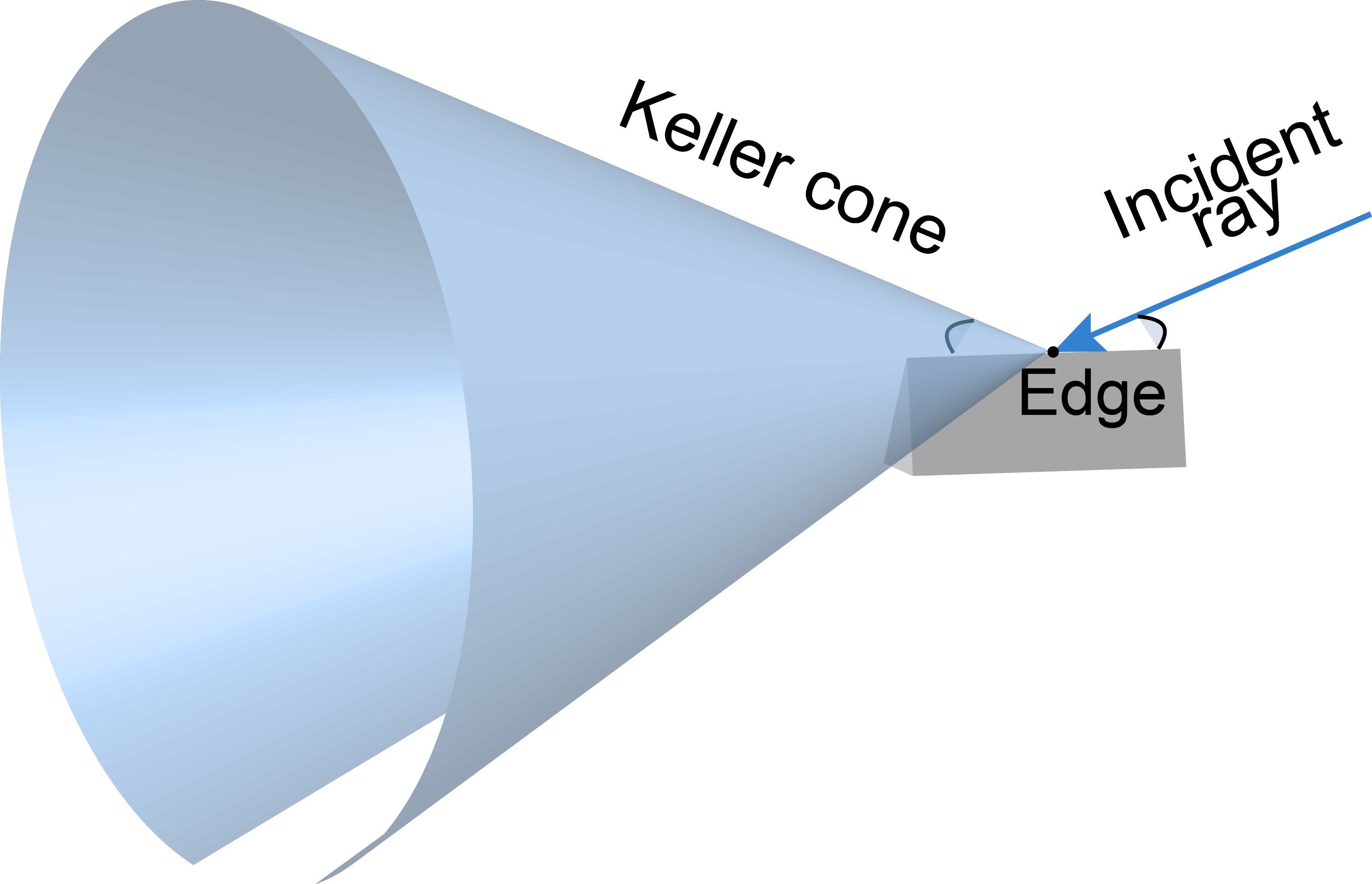
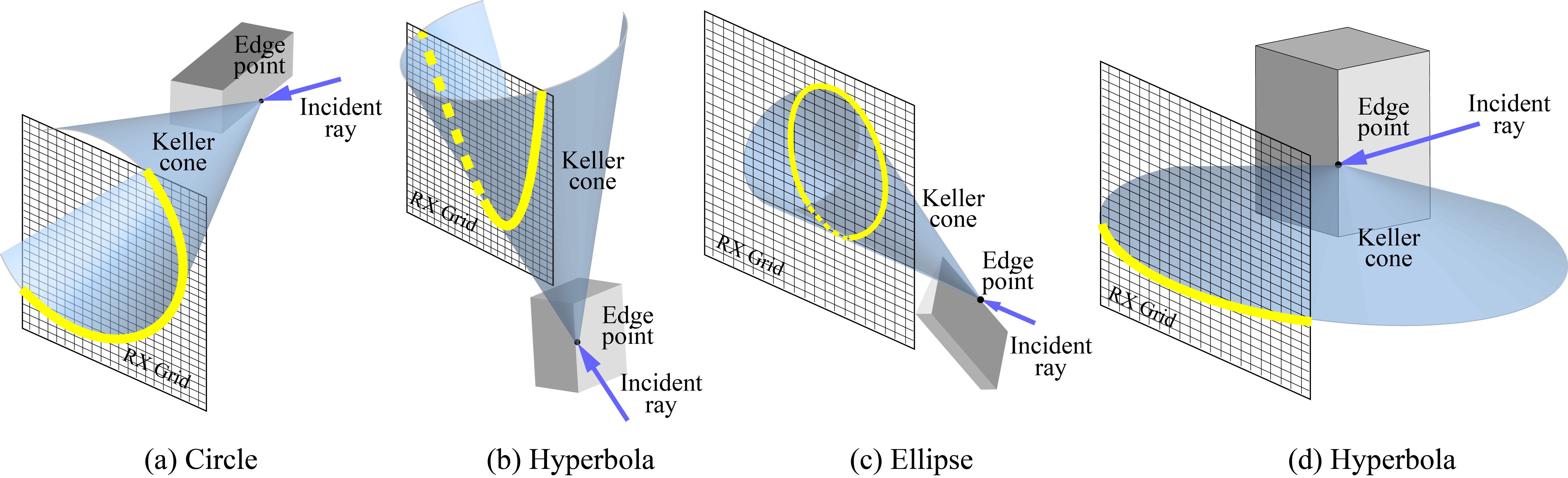
If we consider a receiver grid in the vicinity of the edge, the edge leaves different signatures on the grid depending on its orientation and the direction of the incident ray. More specifically, the RX array elements at the intersection of the RX plane and the corresponding cone are the ones that receive the signal power and thus "see" the impact of that edge point. The intersection of the Keller cone with the RX plane will result in different 2-D shapes (e.g., hyperbola, ellipse, circle, etc.), formally referred to as conic sections.
We have used Support Vector Machines(SVMs) classifiers on Channel State Information(CSI) signals along with the help of OpenCV Canny Edge Detection. The CSI is converted into a heat map which can filter through multiple types noises produced by different sources.